
Talk to your home. It answers.
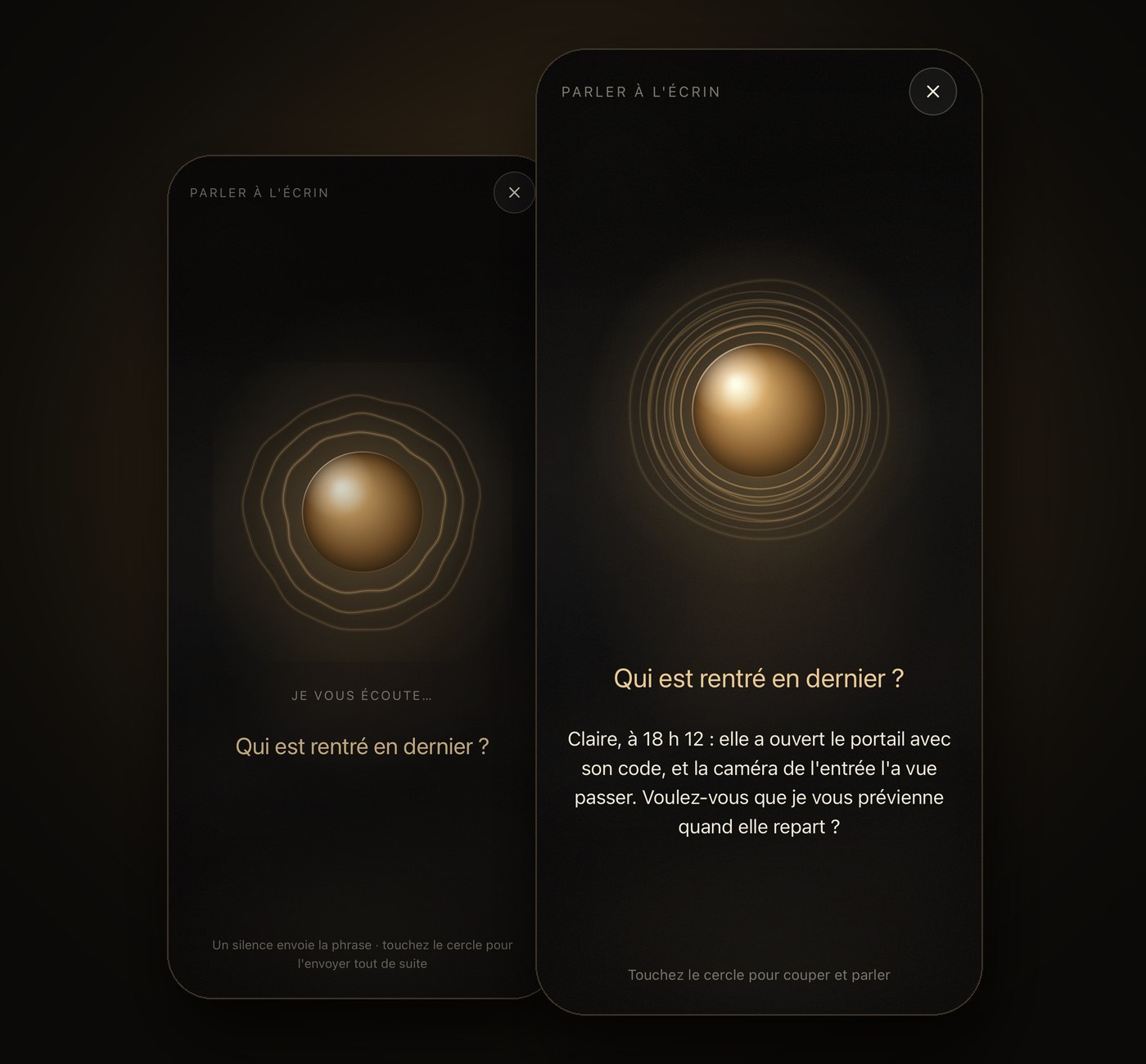
Who came home last?
Claire, at 6.12 pm: she opened the gate with her code, and the entrance camera saw her come in. Would you like me to let you know when she leaves?
Demonstration: the voice is the Écrin’s. In your home, it is your own house that answers.
Touch the sphere and speak as you would to a person: ‘who came home last?’, ‘add butter to the list’, ‘add the dentist on Tuesday at 10 am’. Your home’s Écrin understands, acts by itself within your permissions, and answers you aloud.
Online purchase opens soon. In the meantime, your installer can activate the option on your home: contact us.
What you can say to it
No commands to learn: you speak as you would to someone in the household. It understands the room, the device, the intention. And when it does not know, it says so.
Act
‘Turn everything off downstairs.’Lights, shutters, ambiences, air conditioning, music: said and done, within the permissions of the person speaking.
Know
‘What’s been left on?’Energy, water, alerts, weather: it reads your home and answers you in a sentence.
Who’s there
‘Who came home last?’The video intercom, the cameras, presence: it looks for the answer, and lets you know when the person leaves, if you ask it to.
Shopping
‘Add butter and bread.’The household’s shared shopping list: add, read back, cross off, each from their own phone.
The schedule
‘Add the dentist on Tuesday at 10 am.’The family schedule can be read and written by voice: after your ‘yes’, it is the iPhone that records the appointment.
Rules
‘Every evening at 10 pm, close the shutters.’It suggests the rule; you adopt it from the Home screen. Nothing is created without you.
What the assistant can read
Before answering, it looks through what the home knows. That is how it can tell you who came home, and at what time.
- The video intercomEntries by code, with the first name given to the code.
- The camerasWhat they have seen: a person, a vehicle, where and when.
- PresenceWho is at home, who has just left.
- The alarmArmed or not, and what has happened.
- VehiclesThe EV charger, charging, and the battery with the Cars option.
- EnergyWhat the home has consumed, produced and cost.
- The scheduleThe family’s appointments, over fourteen days.
- The shopping listWhat is missing, and who added it.
A real conversation, without touching the screen
In the ÉCRIN HOME app, voice mode opens a conversation with your home.
- One touch is enoughThe brain at the top of the Home screen opens the voice page. You speak, and a pause sends the phrase.
- It answers you aloudA natural French voice, and the golden sphere breathes with it. The answer also appears on screen.
- The conversation carries onAfter its answer, the home listens again of its own accord. Say ‘Thank you, that’s all’ to finish.
- Never listening all the timeNo microphone left open waiting for a wake word: the Écrin only listens when you ask it to.
Your voice stays at home
Your iPhone listens
Speech recognition happens on the iPhone itself: your voice is neither sent anywhere nor recorded. Only the text of what you said goes any further.
The home understands and acts
Your Écrin hands the phrase to the artificial intelligence, which understands it. It is the Écrin, in your home, that carries out each action, with your permissions.
It answers you
Its answer is spoken by a natural French voice, produced in Paris, and played by your phone, within a few seconds.
With Amazon Alexa
‘Alexa, turn on the living-room ceiling light.’ The ‘ECRIN HOME’ skill, included in the Assistant option, is available in the Alexa app. Requests made to Alexa do not count towards the 20 voice commands a day.
The home, by voice
Lighting, shutters, heating, air conditioning, sockets and your scenes, in the Alexa app and on your Echo speakers, with your routines.
Everyone with their own permissions
Each person links their own Amazon account to their ÉCRIN account, and you choose the home to link: only one per Amazon account. Alexa does no more than its access allows in the app.
Never the gate
A voice can be imitated, a speaker can be heard through a window: the gate, the locks, the alarm, the cameras, protected devices and those your installer reserves for automations are never offered to Alexa.
In the Alexa app: More › Skills & Games, search for ‘ECRIN HOME’, touch ‘Enable’, sign in with your ÉCRIN account, then choose the home to link. Your voice is understood by Amazon, under its own privacy policy; ÉCRIN receives only the request as understood. The details: the privacy page. Amazon, Alexa, Echo and all related marks are trademarks of Amazon.com, Inc. or its affiliates.
What every ÉCRIN home already has
Artificial intelligence is part of ÉCRIN, at no extra cost: three understated features, for whoever receives the home’s alerts. The Assistant adds conversation, by voice or by keyboard.
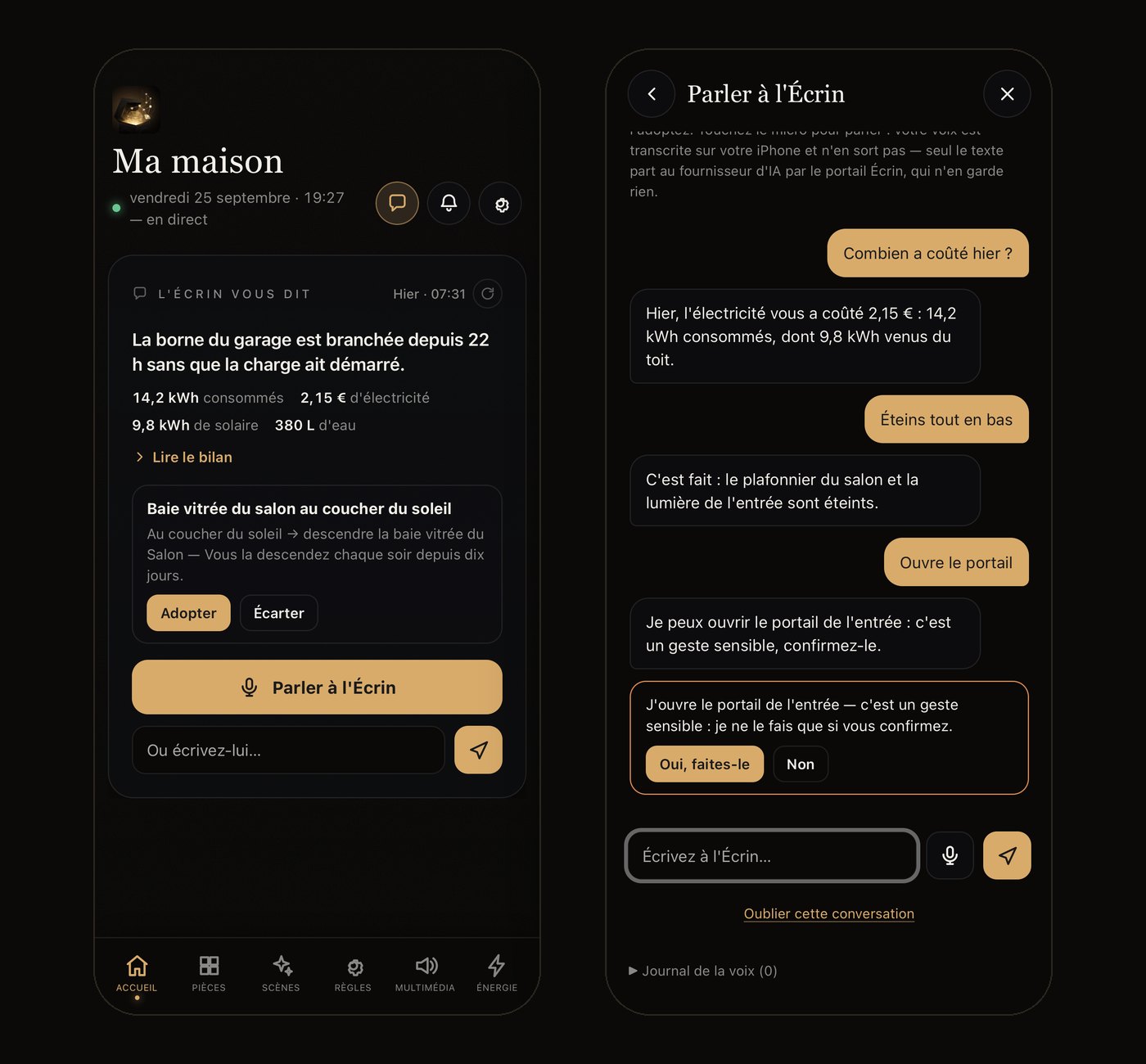
- The daily summaryEvery morning, on the ‘Your Écrin says’ card: what the home has consumed and produced, what is wrong, what the automations have done.
- ‘Explain’ an alertOn every alert from the home, a button: what is happening and what you can do. An explanation, not a diagnosis.
- Suggested rulesWhen the home recognises a habit, it suggests a rule, never for a gate, a lock, the alarm or a camera. Nothing is created without your ‘Adopt’.
Helpful, never reckless
- It is your Écrin that actsThe artificial intelligence understands the phrase. Your home’s Écrin carries out each action itself, with the permissions of the person speaking. No more than they have in the app.
- Never a sensitive action without youGate, lock, alarm, camera: the Écrin reads back what it has understood and waits for your ‘yes’, aloud or with a touch on ‘Yes, go ahead’. The confirmation is handled in your home, without going back through the artificial intelligence.
- Rules suggested, never imposedA dictated rule arrives on the Home screen card, to adopt or dismiss.
- Without internet, the home carries onThe Assistant needs the internet to understand your phrases and for its voice. Your scenes and your rules do not depend on it.
What leaves the home, stated plainly
What goes out
Text, nothing else: your phrase, as the iPhone understood it, your first name, the day’s figures, the list of devices and their rooms, what is wrong, the weather, and, when you ask about the home, what it knows within the limits of your permissions: the first names of those present, the names of the gate codes, what the cameras have seen, the cars’ battery, the calendar and the shopping list. It travels through our servers, which keep none of it, to the artificial intelligence provider (Anthropic and its Claude models); the answer then goes, to be spoken, to Microsoft’s voice service (Azure), in Paris.
What never goes out
Your voice: it is recognised on the iPhone and never leaves it. No images from your cameras, no location, no addresses from your network, no passwords. A conversation is forgotten after thirty minutes, and the Écrin writes none of it to its disk, except an answer you flag with ‘Not that’, kept for your installer.
Not for training
Under Anthropic’s terms, what you say is not used to train its models, and the voice service keeps neither the text nor the sound. We will not tell you that everything happens in your home: your phrases are understood by an artificial intelligence provider, and we would rather tell you so.
The details, and your rights: the privacy page.
The Assistant, plainly
How do I get it?
Online purchase opens soon. In the meantime, your installer can activate the option on your home: contact us. It reaches your Écrin within a minute. In the app, touch ‘Refresh’.
How many times a day can I talk to it?
The option includes up to 20 voice commands a day per home: enough to control, ask and dictate every day. A command is a phrase the Écrin hands to the artificial intelligence; if it has to look up several things to answer you, it still counts as one. Simple actions it understands by itself (‘turn on the kitchen’, ‘turn everything off’), your ‘yes’ to a sensitive action, the daily summary and an alert explanation do not count, nor does a request that did not go through. The counter can be read in the app, under Configuration, Talk to the Écrin: ‘7 / 20 today’. Beyond that, the Écrin tells you so (‘I’ll pick up again tomorrow’), and simple actions still work. Its natural voice reads around twenty answers a day; beyond that, your iPhone’s voice takes over until the next day.
Why €129 a year?
Every exchange goes through an artificial intelligence provider, and every answer is spoken by a natural voice produced in Paris: two services billed to us according to use. The option covers them for the whole home. The daily summary, alert explanations and suggested rules remain included for everyone.
Do I need special equipment?
No. Your Écrin and the ÉCRIN HOME app on iPhone or iPad are enough. You touch the sphere, or the brain at the top of the Home screen, and you speak.
Is it always listening?
No. There is no wake word to wait for: the microphone only opens when you touch the sphere, and closes when the conversation ends. Your voice is recognised on the iPhone, never sent.
Who in the household can talk to it?
The people of the household who have the app, each with their own permissions: the Assistant does no more than the person can do themselves in the app. The option is taken once per home.
Can it open the gate or disarm the alarm?
Only if you confirm it: it reads back what it has understood, then waits for your ‘yes’, aloud or with a touch on ‘Yes, go ahead’. And never in a suggested rule.
Does it work with Amazon Alexa?
Yes. The ‘ECRIN HOME’ skill, included in the option, is available in the Alexa app. Each person links their Amazon account to the home of their choice and controls the lighting, shutters, air conditioning, sockets and scenes by voice, within their own permissions, never the gate, the locks or the alarm. These requests do not count towards the 20 voice commands a day.
And without the Assistant?
Nothing is missing: ÉCRIN remains complete without it, and the included artificial intelligence (the summary, the explanations, the suggestions) is there for every home.
Talk to your home
€129 a year per home, including VAT, up to 20 voice commands a day. Online purchase opens soon. In the meantime, your installer can activate the option: contact us.